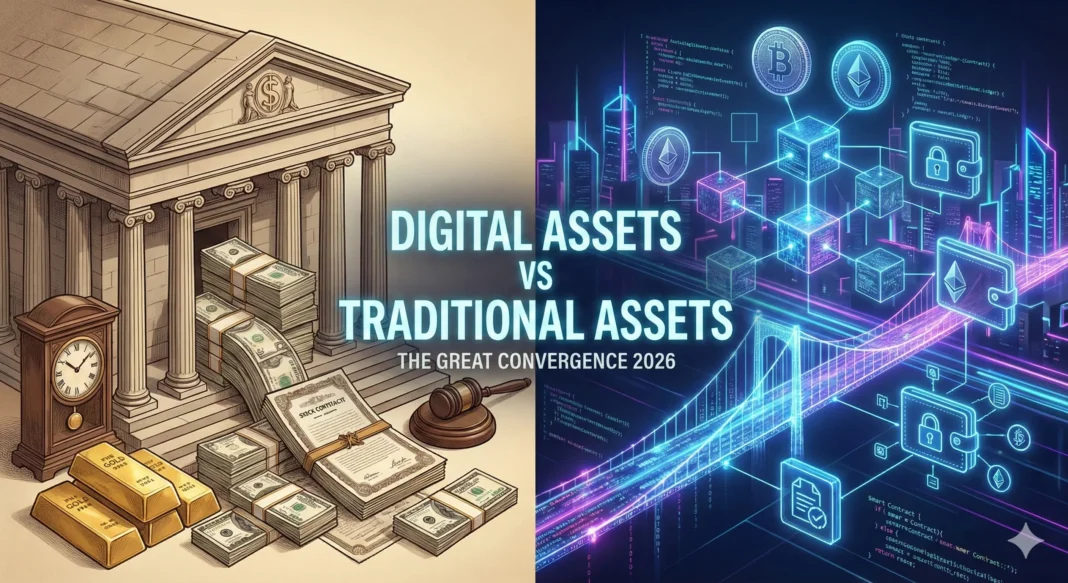

The financial landscape of 2026 is no longer defined by a divide, but by a convergence. As major institutions like BlackRock and J.P. Morgan deepen their integration of blockchain technology, the line between Digital Assets vs Traditional Assets is blurring faster than anticipated. For investors, understanding the distinction is no longer just about choosing between Bitcoin and bonds. It is about recognizing how ownership itself is evolving.[1]
While traditional assets represent the bedrock of the global economy-stabilized by centuries of regulation-digital assets are rewriting the rules of accessibility, settlement speed, and liquidity. With the tokenized real-world asset (RWA) market crossing $30 billion in late 2025, the “Institutional Era” has officially arrived. This guide breaks down the critical differences, risks, and opportunities shaping portfolios in 2026 and beyond.[2]
1. Defining the Asset Classes in the 2026 Economy
To navigate this shifting terrain, investors must first understand the fundamental definitions, which have expanded significantly over the last two years.
Traditional Assets: The Bedrock of Finance
Traditional assets encompass the financial instruments that have dominated markets for the last century. These include equities (stocks), fixed income (bonds), real estate, commodities (gold, oil), and cash equivalents. They are typically issued by central authorities-governments or corporations-and trading them relies heavily on intermediaries like brokers, clearinghouses, and banks.[3]
- Key Characteristic: Centralized ownership records and reliance on intermediaries.
- 2026 Status: Remains the dominant store of global wealth but is increasingly plagued by settlement inefficiencies and limited accessibility for retail investors in private markets.
Digital Assets: The Programmable Future
Digital assets are value representations recorded on a distributed ledger (blockchain). In 2026, this category has matured beyond just cryptocurrencies like Bitcoin (BTC) or Ethereum (ETH). It now includes stablecoins, Central Bank Digital Currencies (CBDCs), and Security Tokens.[4]
- Key Characteristic: Decentralized or distributed settlement, programmability (smart contracts), and 24/7 transferability.
- 2026 Status: Moving from a “speculative” asset class to a “utility” phase. As noted in recent reports by Grayscale Research, 2026 marks the end of the “four-year cycle” volatility theory as utility drives valuations.[5]
2. Liquidity and Market Accessibility: The 24/7 Revolution
One of the most stark differences when comparing Digital Assets vs Traditional Assets is the concept of “market hours” and access.
The “9-to-5” vs. “Always On”
Traditional markets operate on rigid schedules. If you wish to sell a stock on a Friday evening, you are locked in until Monday morning. Furthermore, settlement-the time it takes for cash to actually change hands-has improved to T+1 (one day) in US markets, but this still lags behind the instant finality of blockchain.
Digital assets never sleep. Markets operate 24/7/365. A transfer of USDC (a stablecoin) or a tokenized bond can be settled on Sunday at 3:00 AM just as easily as Tuesday at noon. For global investors, this removes the friction of time zones and bank holidays.
Fractionalization: Democratizing Ownership
High-value traditional assets, such as commercial real estate or private equity funds, have historically been gated behind high minimum investments (often $250k+).
Note: Digital assets solve this via fractionalization. Through tokenization, a $50 million apartment complex can be divided into 50 million digital tokens. An investor can buy $100 worth of that building and receive proportional rental yield instantly.
3. Risk Profiles and Volatility: A Bifurcated Market
The risk methodology for Digital Assets vs Traditional Assets is evolving. In 2025, we witnessed a “bifurcation” where utility-based digital assets began decoupling from purely speculative “memecoins.”
Traditional Stability vs. Inflation Risk
Traditional assets are generally viewed as lower risk, particularly government bonds and blue-chip stocks. They are backed by cash flows, physical inventory, or government tax revenue. However, they carry inflation risk. As fiat currencies face debasement, holding cash or low-yield bonds can result in negative real returns.
Digital Volatility vs. Asymmetric Upside
Digital assets are historically more volatile. However, data from Fidelity International suggests that as liquidity deepens, Bitcoin’s volatility is trending downward, behaving more like a “digital gold.”
- The New Risk: The primary risk in 2026 is Smart Contract Risk (code bugs) and Regulatory Risk (though this is improving with the US “Clarity Act”).
- The Opportunity: Digital assets offer “asymmetric upside”-the potential for exponential returns that far outpace the S&P 500, albeit with a higher chance of drawdown.
4. The Great Convergence: Tokenization of Real-World Assets (RWA)
The most exciting trend for 2026 is the bridge between these two worlds. Real-World Asset (RWA) tokenization is the process of placing traditional assets (like US Treasury bills, gold, or art) on the blockchain.[6]
Why Institutions Are Moving On-Chain
According to CoinGecko’s 2025 RWA Report, this sector is exploding because it combines the stability of traditional assets with the efficiency of digital assets.
- BlackRock’s BUIDL Fund: A prime example where investors hold a token that represents shares in a US Treasury fund. They get the safety of a Treasury bond but the ability to transfer it peer-to-peer instantly.[7]
- Private Credit: $500M+ in private loans are now active on-chain, allowing transparency that traditional “shadow banking” cannot match.
Comparison Table: The Convergence
| Feature | Traditional Assets | Digital Assets (Crypto) | Tokenized RWAs (The Hybrid) |
| Settlement | T+1 Days | Instant / Seconds | Instant / Seconds |
| Trading Hours | Market Hours (M-F) | 24/7 | 24/7 |
| Transparency | Quarterly Reports | Real-time On-chain | Real-time On-chain |
| Yield Source | Dividends/Interest | Staking/Protocol Fees | Real-world Cash Flow |
Conclusion
The debate of Digital Assets vs Traditional Assets is shifting from competition to integration. In 2026, the question is no longer whether to hold digital assets, but how to integrate them into a diversified portfolio.[8]
Traditional assets offer regulatory safety and historical predictability. Digital assets offer unparalleled liquidity, speed, and programmable efficiency. The winners of this decade will be investors who utilize the “hybrid” model-leveraging tokenized traditional assets to gain the best of both worlds.[9]
As Larry Fink, CEO of BlackRock, famously forecasted, the tokenization of financial assets is the “next generation for markets.” In 2026, we are no longer waiting for that generation; we are living in it.[10]
People Also Asked
What is the main difference between digital assets and traditional assets?
The primary difference lies in settlement and custody. Traditional assets rely on centralized intermediaries (banks, brokers) and settle over days (T+1), whereas digital assets rely on decentralized blockchains and settle nearly instantly, operating 24/7.
Are digital assets riskier than traditional assets?
Generally, yes. Digital assets exhibit higher price volatility and technical risks (such as wallet security). However, tokenized traditional assets (like on-chain Treasury bills) carry the same underlying credit risk as their traditional counterparts, just with different settlement rails.
Will digital assets replace traditional assets?
It is unlikely they will replace them entirely, but they will upgrade them. The trend for 2026 is “convergence,” where traditional assets (stocks, bonds) are issued as digital tokens to improve efficiency. This creates a hybrid model rather than a total replacement.
How do I invest in digital assets vs traditional assets safely?
For traditional assets, use regulated brokers. For digital assets, stick to reputable exchanges or regulated ETFs (Exchange Traded Funds). In 2026, many “traditional” brokers now offer access to both, allowing you to manage a hybrid portfolio in one place.[11]