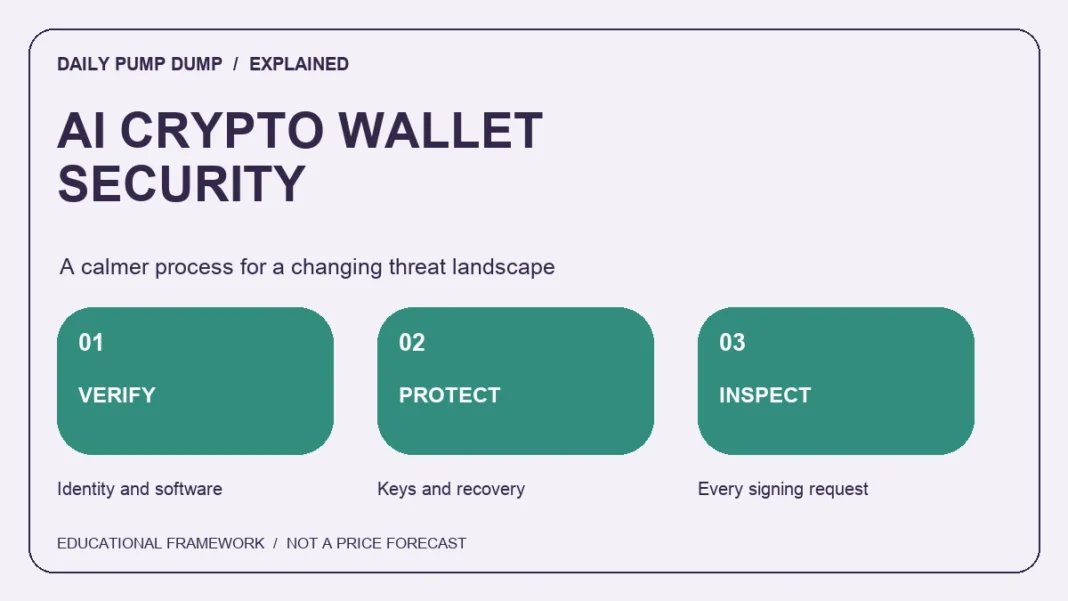

AI crypto wallet security starts with a simple distinction: an attacker does not have to break a blockchain to steal from its users. A convincing impersonation, a malicious download, a leaked recovery phrase, or an unsafe transaction approval may be enough. Artificial intelligence can make some attacks faster or more persuasive, while the consequences still depend on the permissions and secrets an investor exposes.
In a November 18, 2026 post, Bitcoin security engineer Jameson Lopp discussed how powerful tooling is changing vulnerability discovery. That is a warning about the software threat environment, not evidence that AI can simply guess every private key. For individual holders, it reinforces the value of a security process that remains useful when a message looks convincing.
Separate four ways crypto losses happen
First, account compromise can give an attacker control of a custodial platform login or an email account used for recovery. Second, secret theft can expose the keys or backup material controlling a self-custody wallet. Third, a user can authorize an unwanted transfer or permission. Fourth, an investment scam can persuade someone to send funds willingly to a fraudulent operation.
These routes need different defenses. A stronger exchange password does not fix an exposed seed phrase. An offline signing device does not guarantee that the transaction shown on its screen is economically sensible. A successful small withdrawal from an investment website does not prove that the website is legitimate.
The FBI’s public alert about generative AI and financial fraud describes AI-assisted text, imagery, audio, and video used to make deception more believable. The practical lesson is to verify identity and authority through a separate, established channel instead of judging a request by its production quality.
Build a permission map before choosing tools
| Attack route | What the attacker wants | Independent check |
|---|---|---|
| Fake support or recovery page | Recovery words or a passphrase | Use the wallet maker’s established recovery instructions |
| Malicious software download | Device or browser access | Navigate independently to the official software source |
| Misleading signing request | A transfer or spending permission | Read the requested action and verify transaction details |
| AI investment impersonation | A deposit into a fraudulent scheme | Verify the firm and contact through independent records |
This map is deliberately organized by the thing being surrendered. A recovery phrase is a secret. A token approval is a permission. A deposit is a transfer. Labeling the action before approving it makes it harder for an urgent story to hide what will actually happen.
Protect recovery material from ordinary disclosure
A wallet backup can be the route to restoring access after a device fails, but it can also become a route for theft. Understand the backup method your particular wallet uses. Recovery phrases, optional passphrases, and multi-share arrangements are not interchangeable, and an incomplete understanding can create a recovery failure even without an attacker.
Trezor’s phishing guidance explains that support impersonators and fake applications may seek wallet backup material. Do not send recovery words to a purported support agent or enter them into a site reached through an unsolicited message. Follow your own device’s documented recovery procedure, obtained independently from its official source.
Make an inventory of where sensitive material exists without putting the secrets themselves into that inventory. Consider photos, cloud notes, shared folders, printed copies, and old devices. The purpose is to identify exposure and recovery dependencies, not to create one convenient document containing everything required to move the funds.
Separate long-term storage from frequent interaction
A wallet used for experiments and routine transactions has a different risk profile from a reserve wallet that rarely signs anything. Using the same wallet for both can give a single mistake consequences far beyond the amount intended for an experiment.
Bitcoin.org’s wallet-security guidance discusses backups, offline signing, software maintenance, and keeping everyday-use balances limited. The broader design principle is compartmentalization: limit what one compromised component can authorize. The appropriate arrangement depends on the chain, the wallet, and the owner’s ability to maintain it correctly.
A useful hypothetical exercise is to draw every path from a browser session to your largest holding. If one browser extension can request a signature from the reserve wallet at any moment, the reserve is more exposed to your browsing workflow than its label suggests. Conversely, adding devices without understanding recovery may exchange theft risk for permanent-loss risk.
Treat every signature as a financial decision
Before approving an action, identify the network, the asset, the recipient or contract, the amount, and any permission being granted. Connecting a wallet, signing a message, approving token spending, and transferring an asset are different actions. A user interface that blurs those distinctions deserves additional scrutiny.
For smart-contract networks, an allowance may permit future spending up to a specified amount. A transaction that does not immediately move tokens can therefore still change risk. Review existing permissions using trustworthy, independently verified tools appropriate to the network, and understand the consequences before revoking or replacing anything.
A small test transfer can help verify an address and process. It does not certify an investment business, prove that a contract is safe, or guarantee that a later, different approval is harmless. Use tests for the specific question they answer rather than as a general seal of legitimacy.
Use an independent-channel rule for urgent requests
Imagine receiving a realistic voice message from someone claiming to be your wallet provider. They say an exploit requires an immediate migration. Even if the voice, logo, and terminology appear authentic, the requested action must pass the same checks as an ordinary transaction.
End the interaction and navigate independently to the provider’s established support channel. Do not reuse the sender’s link or phone number as the verification channel. If another person is involved in managing the assets, agree in advance how exceptional transfers are confirmed. A previously defined process is more dependable than improvisation under time pressure.
Similarly, an AI trading service’s polished dashboard or an apparent celebrity endorsement does not verify its business. The SEC’s crypto-scam investor alert describes relationship-based approaches and other persuasion tactics. Separate the decision to invest from the technical act of sending cryptocurrency.
Questions readers also ask
How secure is a crypto wallet?
Security depends on its architecture, implementation, backup handling, devices, and user decisions. No single security label establishes that every part of that process is safe. Evaluate how theft, device loss, and mistakes would be handled in your actual setup.
Which crypto wallet has the best security?
There is no universally best wallet for every user. Compare supported assets, signing transparency, recovery design, software provenance, and your ability to operate the system. Additional complexity is useful only when you can manage it reliably.
Can a crypto wallet be hacked?
Yes, wallets and their surrounding software can contain vulnerabilities, and people can be deceived into disclosing secrets or signing harmful actions. Those are different from defeating the underlying blockchain’s cryptography. Diagnose the actual attack route before choosing a defense.
How do you protect a crypto wallet from hackers?
Reduce exposed balances, protect recovery material, verify software sources, maintain supported software, and inspect requested permissions. For custodial accounts, also secure the email and authentication methods that control account recovery. Combine controls so one failure does not automatically expose everything.
Prepare a calm response before an incident
If you suspect compromise, stop interacting with the suspicious site and preserve relevant transaction and communication records. Use a separate trusted device and official support channels to assess the affected accounts or wallets. Do not pay a stranger who promises guaranteed recovery. The correct next action depends on whether an account, a device, a permission, or the keys themselves were exposed.
Also Read: Crypto Investing vs Trading explains why the frequency and purpose of transactions should influence how you organize operational risk.
Educational security guidance. No device, wallet, or custody arrangement can guarantee protection against every loss.