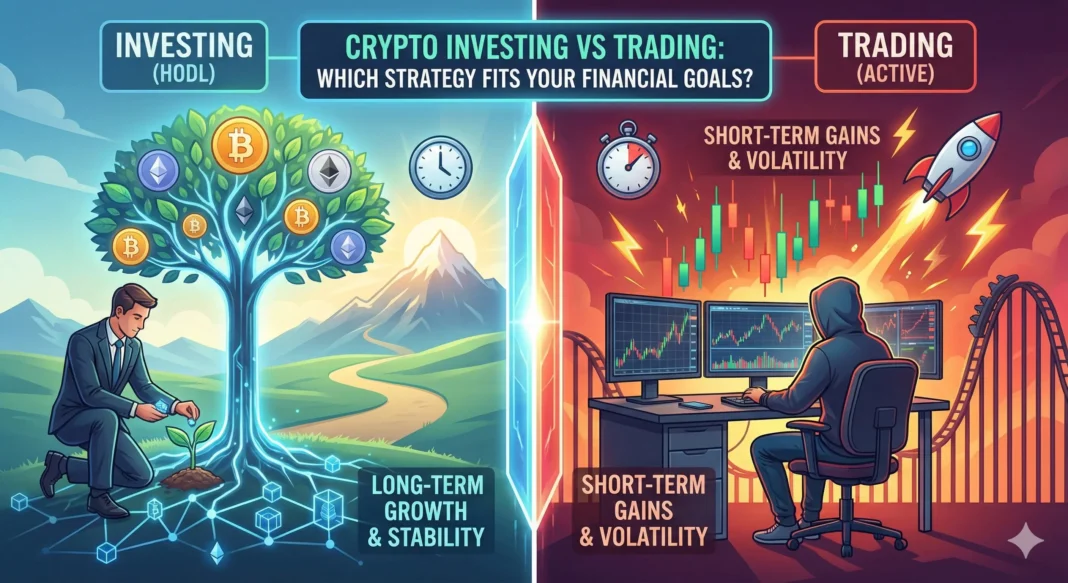

The digital asset landscape has matured significantly entering 2026, yet the fundamental debate remains: is Crypto Investing vs Trading the superior path to wealth generation? For newcomers and seasoned financiers alike, the answer isn’t binary-it depends entirely on your risk tolerance, time horizon, and financial objectives.
In the current market cycle, Bitcoin has stabilized as a macro-asset while altcoins continue to offer high-beta volatility. Understanding the nuance between passively holding digital assets and actively trading them is no longer just about preference; it is about survival. Whether you are looking to build a retirement-grade portfolio or generate monthly cash flow, choosing the right approach requires dissecting the mechanics of Crypto Investing vs Trading in a post-ETF world.
The Case for Crypto Investing: The Power of the “HODL”
Crypto investing, often colloquially known as “HODLing,” mirrors the traditional buy-and-hold strategy used in equity markets but applied to blockchain assets.
Long-Term Value Accrual in 2025-2026
As of early 2026, institutional adoption has shifted the investing thesis. With major financial players like BlackRock and Fidelity managing billions in spot crypto ETFs, the “digital gold” narrative for Bitcoin has solidified. Investing involves purchasing assets with strong fundamentals-like Bitcoin (BTC), Ethereum (ETH), or Solana (SOL)-and holding them for years regardless of short-term price action.[1]
Data from late 2025 indicates that long-term holders (investors holding for >155 days) control over 76% of the available Bitcoin supply. This supply shock typically drives price appreciation over multi-year cycles, rewarding patience over activity.
The “Set It and Forget It” Advantage
For investors with limited time, this strategy is superior. It removes the psychological stress of monitoring 24/7 markets. By utilizing Dollar-Cost Averaging (DCA), investors mitigate the risk of buying at a local top, smoothing out their entry price over time.
The Case for Crypto Trading: Capturing Alpha in Volatility
In contrast to investing, crypto trading is the active participation in the market to exploit short-term price movements. [2]
Navigating High-Frequency Markets
Traders do not necessarily care about the long-term viability of a project; they care about liquidity and volatility. In 2026, volatility remains the trader’s lifeblood. While Bitcoin’s volatility has dampened compared to 2020, sectors like Real World Assets (RWA) and DePIN (Decentralized Physical Infrastructure Networks) offer massive intra-day swings.
Active traders utilize technical analysis, on-chain data, and leverage to amplify returns. A skilled trader might short the market during a downturn-profiting when prices fall-something a strict HODLer cannot do.
The Risks of Active Management
However, the data is sobering. Studies consistently show that over 80% of day traders underperform the market index over a 12-month period. Trading requires a professional understanding of market structure, order flow, and risk management. It is a full-time job, not a passive income stream.
Critical Differences: Risk, Time, and Taxes
To truly decide between Crypto Investing vs Trading, you must evaluate three core metrics that define your financial reality.
1. Time Commitment and Psychological Toll
Investing is passive; trading is active.
- Investors: Spend 1-2 hours a month reviewing portfolio rebalancing.
- Traders: Spend 4-8 hours daily analyzing charts and news.
- Insight: If you have a demanding 9-to-5 job, active trading often leads to burnout and emotional decision-making, the enemy of profit. [3]
2. Tax Implications (2025-2026 Updates)
The regulatory environment has tightened. In the United States, the IRS has ramped up enforcement.
- Investing (Long-Term Capital Gains): Assets held for more than 12 months benefit from significantly lower tax rates (0%, 15%, or 20% depending on income).
- Trading (Short-Term Capital Gains): Profits from assets held less than a year are taxed as ordinary income, which can be as high as 37%.
- The 2026 Shift: New reporting requirements (Form 1099-DA) mean every trade is transparent to tax authorities. High-frequency trading now carries a heavier administrative and tax burden than ever before.
3. Risk Profile
- Investing Risk: Systemic risk (the whole market crashes) or protocol failure (a specific coin goes to zero).
- Trading Risk: Execution risk (bad timing), liquidation risk (leverage wipes out account), and emotional risk (panic selling).
Hybrid Strategies: The Modern Approach
Sophisticated market participants often refuse to choose just one side of the Crypto Investing vs Trading debate. Instead, they adopt a “Core-Satellite” approach.
The Core-Satellite Portfolio
- The Core (80%): Long-term cold storage holdings of blue-chip assets like BTC and ETH. This portion is never traded, capturing the secular growth of the asset class.
- The Satellite (20%): An active trading account used to speculate on high-risk altcoins or swing trade based on market cycles.
This strategy protects your long-term wealth while allowing you to scratch the itch for speculative gains without risking your financial future.
Conclusion: Aligning Strategy with Reality
Ultimately, the choice comes down to self-awareness. If you seek generational wealth and have low time preference, investing is the mathematically safer bet. If you desire income generation and possess the discipline to master technical skills, trading offers a lucrative, albeit risky, path.
As institutional adoption creates a new floor for prices in 2026, the era of “easy money” is over. Whether you are clicking buy once a month or short once an hour, clarity of purpose is your greatest asset.
“The market is a device for transferring money from the impatient to the patient. In 2026, the winners will be those who understand that investing is about time in the market, while trading is about timing the market-and very few can do both successfully.” – Dr. Aris K., Senior Digital Asset Strategist, Global FinTech Outlook 2026
People Also Asked
Is crypto trading better than investing for beginners? Generally, no. Crypto Investing vs Trading data suggests beginners are safer starting with investing. Trading requires understanding complex technical analysis and risk management, while investing allows for a simpler “dollar-cost averaging” strategy that mitigates volatility risk.
What are the tax differences between crypto trading and investing? In the U.S. and many other jurisdictions, trading triggers “short-term capital gains” tax (up to 37%) if assets are sold within a year. Investing and holding for over a year qualifies for “long-term capital gains” tax (typically 0-20%), making investing more tax-efficient.
Can I do both crypto investing and trading? Yes, this is called a hybrid strategy. Many investors keep 80% of their funds in long-term “cold storage” (investing) and use 20% of their capital for active trading to capture short-term profits without risking their entire portfolio.
How much capital do I need to start crypto trading vs investing? You can start investing with as little as $10 using fractional shares. However, effective trading often requires more capital (typically $2,000+) to properly manage risk and absorb fees without eating into profit margins