Token Economics (or “tokenomics”) is the blueprint of a cryptocurrency’s value proposition—the mathematical and behavioral rules that govern how a digital asset is created, distributed, and removed from circulation. In the maturing landscape of 2025 and 2026, understanding these mechanics is no longer just for developers; it is the primary diligence filter for institutional investors and retail traders alike. [1]
As the crypto market pivots from the speculative frenzy of previous cycles to the “Real Yield” era of today, the definition of sound tokenomics has evolved. It is no longer enough to look at a whitepaper’s pie chart. Today, we must analyze dynamic supply schedules, revenue-share mechanisms, and regulatory-compliant scarcity. Whether you are evaluating a Layer-1 blockchain or a tokenized Real World Asset (RWA), the fundamental question remains: How does the design of this token capture and retain value?
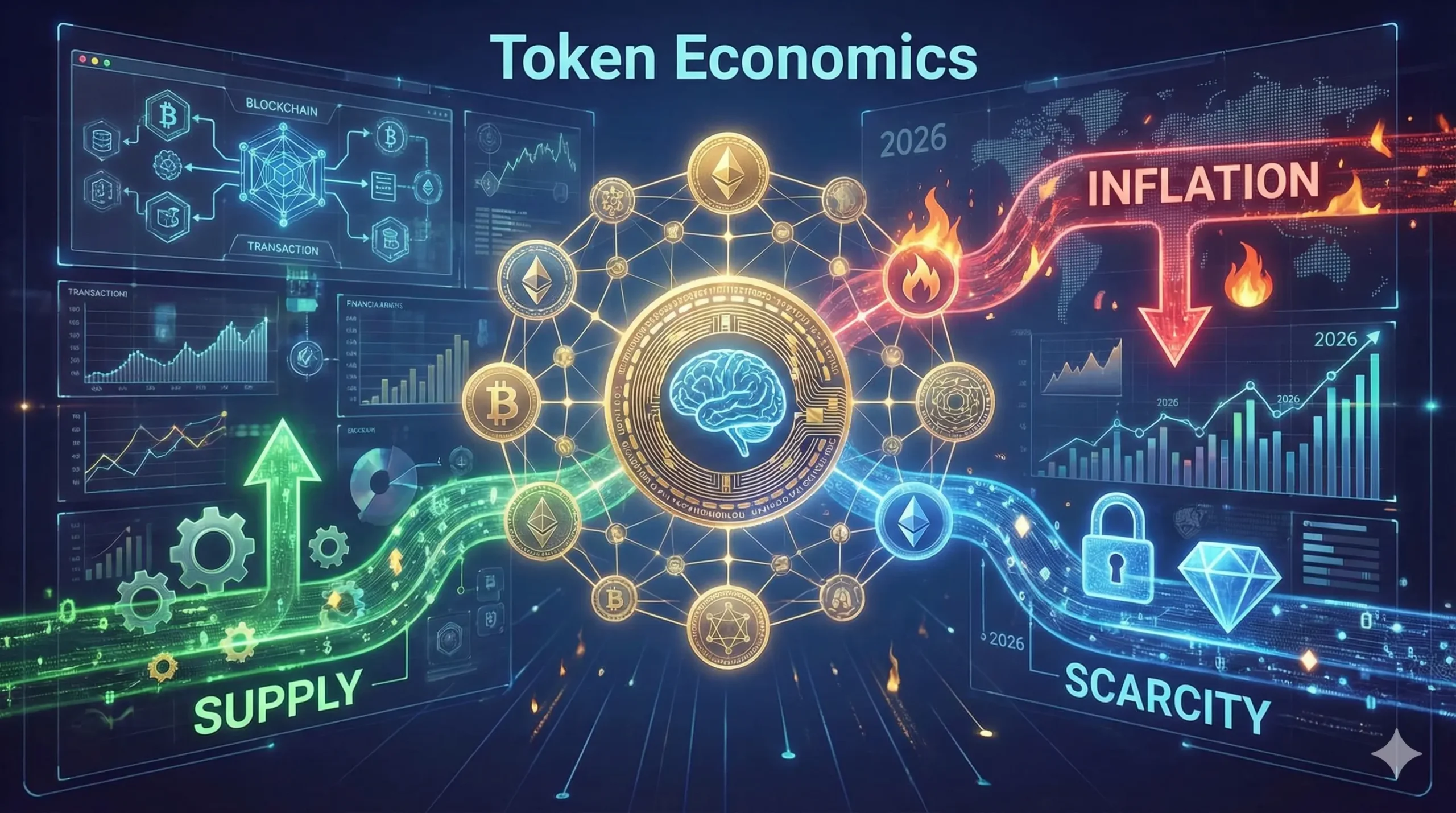
This guide deconstructs the core pillars of token economics—supply, inflation, and scarcity—using the latest data and frameworks from the 2025-2026 market cycle.
1. The Supply Dynamics: Circulating, Total, and the “Float” Problem
The most immediate red flag in modern token analysis is the disparity between supply metrics. In 2026, the market has grown intolerant of “predatory” supply schedules that enriched early venture capitalists at the expense of retail holders.
Understanding the Three Supply Tiers
To accurately assess a token, you must distinguish between three critical metrics:
- Circulating Supply: The number of tokens currently available for trade.[2]
- Total Supply: The number of tokens that have been minted, minus any that have been burned.
- Max Supply: The hard cap on the number of tokens that will ever exist (e.g., Bitcoin’s 21 million).[3]
The “Low Float / High FDV” Trap
A defining controversy of the mid-2020s has been the “Low Float, High FDV” (Fully Diluted Valuation) model. This occurs when a project launches with a small circulating supply (e.g., 10%) but a massive total valuation.
Expert Note: “In 2025, the market began pricing assets based on their FDV rather than market cap. If a token has $100M in circulating liquidity but $10B in locked vesting contracts, that $9.9B of overhang is essentially ‘future inflation’ that will suppress price appreciation for years.”
Smart money now demands linear vesting schedules over 3–5 years rather than the “cliff” unlocks that caused massive sell-offs in previous cycles. When analyzing token economics, always calculate the Mcap/FDV ratio. A ratio below 0.5 suggests significant future inflation pressure.[4]
2. From Inflation to “Real Yield”: The 2025 Revenue Shift
Historically, protocols attracted users by printing new tokens—a process known as emissions. This is inflationary. It dilutes existing holders to subsidize new ones. However, the dominant trend of 2025-2026 is the pivot toward Real Yield.
The End of Hyper-Inflationary Incentives
In the early DeFi eras, APYs of 10,000% were common but unsustainable. They were paid in tokens that were rapidly losing value. Today, sustainable token economics relies on non-inflationary rewards.
- Revenue Sharing: Protocols like decentralized exchanges or lending platforms now distribute a portion of actual trading fees (in USDC, ETH, or SOL) to token stakers.
- Buyback-and-Burn: Instead of distributing fees, some protocols use revenue to buy their own token off the open market and burn it. This reduces supply, theoretically increasing the value of remaining tokens.[2]
Case Study: The Ethereum Standard
Ethereum remains the benchmark for this transition. Following its “Merge” and subsequent upgrades, it shifted to a model where high network activity burns more ETH than is created. As of early 2026, this deflationary pressure during high-traffic periods creates a “triple point” asset: a store of value, a capital asset (staking yield), and a consumable commodity (gas).
3. Scarcity Engineering: Burns, Halvings, and “Points”
Scarcity is not just about a hard cap; it is about the flow of assets. In 2026, scarcity is often engineered through dynamic mechanisms that respond to market demand.
The Halving Model vs. Dynamic Burns
Bitcoin’s halving (a 50% reduction in new supply every four years) is a rigid, predictable supply shock. While effective for a “digital gold” narrative, modern utility tokens prefer dynamic burns.[5]
- Transaction Fee Burns: A percentage of every transaction is permanently removed from circulation.
- Penalty Burns: In “Restaking” ecosystems (popularized by EigenLayer concepts), tokens can be slashed (burned) for malicious validator behavior, ensuring security through economic risk.
The “Points” Pre-Token Meta
A significant evolution in 2025 was the “Points” system. To avoid regulatory classification as a security and to bootstrap loyalty without immediate dilution, projects now issue off-chain “points” for user activity.
- The Strategy: Points act as a dynamic promise of future token allocation.
- The Economics: This allows projects to fine-tune their eventual token generation event (TGE) based on real user data, avoiding the “mercenary capital” that drains liquidity immediately after an airdrop.
4. Institutional Tokenomics: RWAs and Regulatory Compliance
The entry of giants like BlackRock and State Street has birthed a new category: Institutional Tokenomics. As noted in the State Street 2025 Digital Assets Outlook, institutions are “doubling down on tokenization,” with private markets (equity, debt) being the first stop.[6]
Real World Assets (RWAs)
Tokenizing tangible assets (like U.S. Treasury bills or real estate) requires different economic logic than crypto-native assets.
- Backed Supply: Unlike utility tokens which can be minted arbitrarily, RWA tokens must have a 1:1 correspondence with the underlying asset held in custody.
- Compliance Enforced Scarcity: Supply is constrained not by code alone, but by the legal verified assets in the vault.
The Rise of the “Yield-Bearing Stablecoin”
By late 2025, the stablecoin supply surpassed $276 billion, driven by a hunger for yield. New forms of “fiat-backed” tokens now pass the interest earned on treasury reserves directly to holders. This challenges traditional non-yielding stablecoins and forces a rewrite of token velocity models—users are now incentivized to hold stablecoins rather than just spend them.
Conclusion
The era of “Ponzi-nomics” and purely speculative value is ending. In 2026, successful Token Economics requires a alignment of incentives: supply must be disciplined, yields must be derived from revenue, and scarcity must be defensible.
As the market matures, the tokens that outperform will be those that function less like lottery tickets and more like productive assets. The “Low Float” tricks of the past are being regulated out or arbitraged away. The future belongs to protocols that can prove their value on-chain, in real-time.
“The next step is coming with digital assets… tokenization of the market. It’s the way the world will be… maybe a couple of years from now.” — Paul Atkins, discussing the rapid shift toward tokenized financial systems (Context: Late 2025 Market Outlook).[7]
People Also Asked
What is the “Real Yield” in token economics? Real Yield refers to returns generated from actual protocol revenue (such as trading fees or lending interest) rather than from inflationary token emissions. In 2025, this became the gold standard for DeFi sustainability, ensuring that yields are backed by economic activity, not dilution.
How does “vesting” impact token price? Vesting locks tokens for early investors and team members for a set period. Large “cliff” unlocks can cause sudden price drops due to increased supply. Modern tokenomics favors “linear vesting” (unlocking small amounts daily/monthly) to smooth out supply shocks and reduce volatility.
Why is “Fully Diluted Valuation” (FDV) important? FDV represents the market cap of a project if all possible tokens were in circulation today. It helps investors identify overvalued projects. A project with a low current market cap but a massive FDV implies huge future inflation, which often suppresses long-term price growth.
What is the difference between inflationary and deflationary tokens? Inflationary tokens have a supply that increases over time (like Dogecoin), which can dilute value if demand doesn’t keep up. Deflationary tokens (like BNB or post-merge ETH) have mechanisms to reduce supply over time (burns), theoretically increasing scarcity and value per token.
Are “Points” considered cryptocurrency? No. Points are typically off-chain databases used by projects to track user loyalty prior to a token launch. They allow projects to incentivize behavior without navigating complex securities regulations immediately, though they often convert to tokens later during an “Airdrop.”