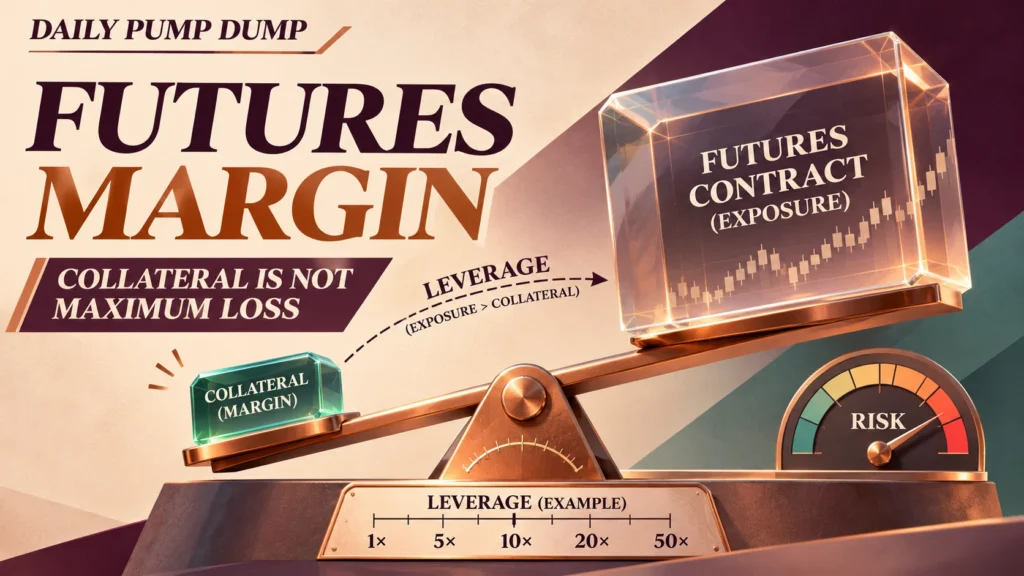
Futures margin is collateral supporting a contract position. It is not the purchase price of the underlying asset and does not cap potential losses. The practical risk is not just whether a market view eventually proves correct, but whether the account can meet cash demands along the way.
A contract can move against its holder, trigger a collateral shortfall and be closed before the anticipated recovery occurs. Margin requirements can also increase during stressed conditions. Understanding contract size, settlement and liquidity is therefore more useful than treating the broker’s minimum deposit as a trading budget.
Begin with exposure, not the deposit
A futures contract specifies an underlying reference, contract size, quotation convention, expiration and settlement rules. Notional exposure is commonly calculated from the quoted price and contract multiplier, but the exact formula depends on the contract. Tick value translates the smallest permitted price movement into money. Always use the exchange’s current contract specification rather than an analogy with another product.
For a simple hypothetical contract representing ten units of an asset quoted at $100 per unit, notional exposure is $1,000. A $1 price change produces a $10 gain or loss per contract. If the margin requirement is much less than $1,000, the price sensitivity still belongs to the whole contract. Posting less collateral does not shrink that sensitivity.
Initial margin and maintenance margin
Initial margin is the amount required to establish a position. Maintenance margin is the threshold that must be maintained while it remains open. CME Group’s margin explainer describes these terms, possible top-ups and liquidation, and why brokers may require more than clearing minimums.
The distinction from buying securities with borrowed money matters. A futures position creates contractual exposure backed by collateral; it is not a partial purchase of the underlying commodity. Exchange requirements, broker house requirements and any intraday concessions can differ. A low advertised intraday margin is especially poor evidence of the amount of capital needed to withstand an adverse move.
A worked margin example
Assume one long contract with a ten-unit multiplier, an opening quote of $100, initial margin of $120 and maintenance margin of $100. The account starts with $150 cash, and no other positions, fees, interest or withdrawals. These invented figures explain the mechanics; they are not specifications for a tradable product.
| Stage | Quote | Change in account equity | Account equity |
|---|---|---|---|
| Open | $100 | — | $150 |
| First adverse move | $96 | −$40 | $110 |
| Further adverse move | $94 | −$20 | $90 |
| Illustrative top-up | $94 | +$30 cash deposit | $120 |
The market has fallen 6%, but the $60 loss equals 40% of the original $150 cash. Under the assumed top-up rule, $30 restores equity from $90 to initial margin of $120. The deposit adds collateral; it does not reverse the trading loss. Actual brokers can require earlier action or close positions instead of waiting for a deposit.
In a separate gap scenario, a direct move from $100 to $80 creates a $200 loss. Starting with $150 would leave a $50 deficit before fees, if execution and settlement occur at those assumed prices. This is why margin is not a maximum-loss guarantee. A stop order does not ensure the market can be exited at the requested price.
Also Read: Stock Market Correction: A Practical Investor Checklist.
Daily settlement changes the cash-flow problem
Open futures positions are marked to settlement prices, with gains and losses reflected through variation settlement. Intraday risk controls can add further demands. A long-term thesis therefore has a short-term financing dimension: an eventual favorable outcome is irrelevant if the holder cannot support the position through interim losses.
Consider a business using futures to hedge an exposure elsewhere. The hedge may offset an economic loss in the underlying business, yet the two cash flows can arrive at different times. A futures gain does not automatically match the timing of an invoice, and a futures loss may require cash before the offsetting business benefit is received. Liquidity planning remains necessary even when the hedge rationale is sound.
Why requirements can rise when cash is scarce
Clearing systems adjust collateral requirements as assessed risk changes. Brokers can impose additional conditions. During volatility, a trader may face both market losses and a higher required buffer. Planning only for a fixed initial deposit misses this combination.
Analyze scenarios in money, not just percentages. Work out the cash effect of one tick, a typical daily move and a larger gap. Add current fees and realistic execution costs. Then assess how multiple positions might move together. Apparently different contracts can become highly correlated during a broad liquidation or currency shock.
Expiration, delivery and rolling
The CFTC’s Futures Market Basics explains the contract framework and settlement risks. Contracts can involve cash settlement or delivery obligations depending on their rules. Do not assume a broker will handle an approaching deadline in the way you expect.
A trader seeking continued exposure may close one expiration and open another. This roll changes the contract held and introduces execution costs and price differences between maturities. The difference is not simply a fee, and a futures strategy’s return need not equal the change in a headline spot price. Commodity storage, financing, supply conditions and the curve’s shape can all matter.
Also Read: Commodity Performance and ETF Returns.
Smaller contracts still require a risk budget
A smaller multiplier can make exposure easier to size, but buying several small contracts can recreate a large position. The relevant unit is total money at risk across the account. Product names containing “micro” or “mini” describe relative contract sizing, not a guarantee of small losses.
Similarly, an exchange-traded product with futures exposure is not identical to holding a futures contract directly. Its legal structure, collateral arrangements, roll policy, fees and investor protections need separate review. Comparing the two requires examining the actual documents rather than assuming a shared underlying asset makes them interchangeable.
Questions to answer before opening a position
- What are the multiplier, tick value and total notional exposure?
- Which initial, maintenance, overnight and broker house requirements apply now?
- How quickly can additional collateral be demanded?
- What happens during a price gap, market halt or loss of liquidity?
- When are the last trading, notice and delivery dates?
- Can the account withstand correlated losses and a margin increase together?
- What are the close-out, roll and deficit-liability terms?
Write the answers before relying on an automated order. A plan that requires an immediate deposit should account for bank-transfer availability, currency conversion and the broker’s actual deadline. Cash outside the trading account may not arrive in time. Where these risks cannot be understood or supported, the appropriate conclusion may be to avoid the position.
Frequently asked questions
Can futures losses exceed the margin deposit?
Yes. The contract’s price exposure can create a loss larger than collateral posted. Fees and adverse execution can add to the deficit.
Is a margin call always followed by a grace period?
No. Broker terms and market conditions can allow rapid liquidation. Do not assume there will be time to transfer money.
Does a hedge eliminate all risk?
No. Basis differences, contract sizing, timing, funding and execution can leave meaningful residual risks even when economic exposure is partly offset.
Also Read: Wealth vs Income.
Research reviewed November 29, 2026. All numerical examples and the cover’s leverage scale are illustrative, not current contract terms or recommendations. Check the exchange specification and broker agreement for the actual product.