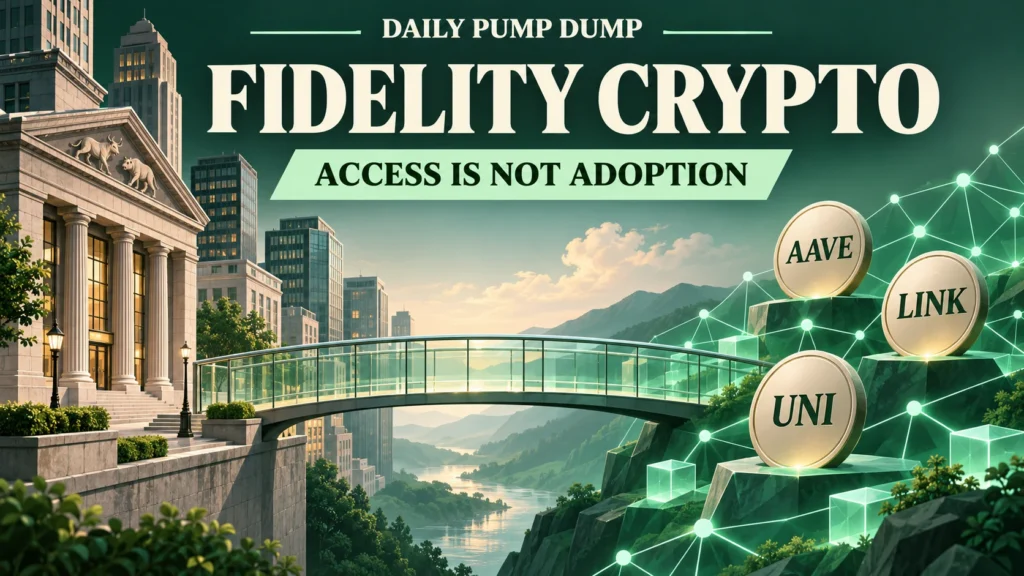
Fidelity Crypto now lists AAVE, LINK and UNI, expanding the assets available through a familiar financial interface. That is meaningful distribution news. It is not, by itself, proof of decentralized-finance adoption, increased protocol revenue or future token returns. Understanding the difference helps readers assess what changes when a traditional financial platform adds digital assets.
The lead came from Uniswap founder Hayden Adams’s November 25 post, which welcomed UNI trading at Fidelity and shared Fidelity’s November 24 announcement. The additions are independently visible on Fidelity’s current crypto-account page. This article distinguishes those verified product facts from the economic questions that still require evidence.
What the announcement changes
Fidelity’s product page includes Aave, Chainlink and Uniswap among the cryptocurrencies available to trade. Availability can reduce the practical effort required for an eligible customer to obtain exposure through an existing financial relationship. The page also makes clear that account eligibility and geographic availability apply. A product listing should not be interpreted as universal access for every reader.
The narrow but important change is an additional distribution route. Distribution can affect discovery, convenience and the pool of potential participants. Measuring its economic significance requires follow-through: sustained customer use, trading activity, custody choices and, separately, the behavior of the underlying networks. An announcement is the start of that evidence trail, not its completion.
Three assets, three different economic questions
AAVE, LINK and UNI should not be treated as interchangeable expressions of one theme. Their respective ecosystems involve lending infrastructure, oracle services and decentralized exchange activity. The official Aave, Chainlink and Uniswap sites provide starting points for understanding those distinct systems. A token’s role must be examined separately from the usefulness of the software around it.
A service can become more widely used without every associated token capturing an equal economic benefit. Governance, security requirements, fees, incentives and supply rules shape that relationship. Readers should investigate the current mechanism rather than assuming that activity automatically flows to token holders in the way corporate earnings may ultimately benefit shareholders.
| Evidence layer | Question to ask | What it cannot prove alone |
|---|---|---|
| Platform listing | Can eligible customers access the asset? | Sustained customer demand |
| Trading activity | Are users actually buying and selling? | Use of the underlying protocol |
| Protocol activity | Are the services being used? | Value accruing to each token |
| Token economics | How do demand, supply and rights interact? | A guaranteed investment return |
Also Read: Token Economics Explained examines supply, inflation and scarcity beyond a token’s headline narrative.
Buying a token is not the same as using DeFi
A customer can hold an asset through a financial platform without borrowing from a decentralized lending market, providing liquidity or operating a self-custody wallet. These are different activities with different responsibilities and risks. Buying UNI does not necessarily mean supplying liquidity to a Uniswap pool, just as buying AAVE does not necessarily mean depositing collateral into a lending position.
That distinction matters for adoption statistics. Brokerage-style access measures participation in an asset market. Onchain activity measures actions recorded by a blockchain, with its own limitations and attribution problems. Neither should be used as a substitute for the other. A strong analysis asks which form of participation is being measured and whether the metric supports the claim being made.
Custody changes the operational question
Self-custody places responsibility for key management and transaction authorization on the holder. A custodial relationship changes who manages those operational tasks, but introduces reliance on a provider and its contractual arrangements. Neither model makes the asset’s market risk disappear. The relevant comparison includes control, recovery procedures, transfer availability and the services actually offered for that asset.
Readers should verify current transfer support and account terms rather than assume that every listed asset has identical features. They should also distinguish a direct crypto holding from a security or fund held in a brokerage account. Familiar branding and a shared application do not make legally or operationally different products equivalent.
Fidelity’s disclosures state that crypto is not protected by FDIC or SIPC insurance and does not carry the same regulatory protections as registered securities. That disclosure should be read alongside the product’s convenience benefits. The absence of an unfamiliar wallet interface does not transform a volatile token into an insured cash balance.
Also Read: Digital Assets vs Traditional Assets explains why access, ownership rights and protection arrangements need separate examination.
Why a listing can matter without guaranteeing demand
New distribution can lower friction, but the size and persistence of the effect are empirical questions. Some customers may already hold the assets elsewhere. Others may prefer a simpler product set or avoid the exposure altogether. Existing holders may transfer custody rather than create net new demand. Each behavior produces different implications for a claim about market expansion.
Market prices may also anticipate announcements. A positive business development can coincide with a disappointing investment return if expectations were already high or broader market conditions deteriorate. The relevant question is not merely whether the news sounds favorable, but how it compares with what investors expected and what valuation already assumed.
A hypothetical concentration check
Imagine a portfolio worth $20,000 that allocates $600 to each of three tokens. The combined allocation is $1,800, or 9% of the portfolio. If all three positions fall by 40% while every other holding remains unchanged, the loss is $720, equivalent to 3.6% of the initial portfolio. This is an arithmetic illustration, not a recommendation or return forecast.
Three different tickers do not necessarily provide three independent sources of risk. Positions can respond to the same liquidity conditions, risk appetite or crypto-market shock. Assess concentration at the level of common drivers as well as individual names. Convenience can make diversification easier, but it can also make overlapping exposures easier to accumulate unnoticed.
What would count as stronger evidence of adoption?
Start with sustained customer engagement rather than a single day’s attention. Then examine whether protocol-specific activity changes in ways consistent with the proposed adoption story. For lending, exchange and oracle systems, the relevant operational measures are different. Definitions, coverage and potential double counting should be documented before comparisons are made.
Finally, connect activity to token economics using current documentation. Ask whether the claimed benefit depends on a governance decision that has not happened, a particular deployment or a mechanism that applies only under certain conditions. Evidence that a protocol is useful does not eliminate the need to analyze the asset offered to investors.
Also Read: Crypto Investing vs Trading helps separate a long-term thesis from a short-term reaction to news.
Questions readers ask about Fidelity’s additions
Can eligible Fidelity Crypto customers trade AAVE, LINK and UNI?
Fidelity’s current product page lists all three. Eligibility, state availability and individual account features still apply, so readers should check the current terms directly.
Does buying these tokens mean participating in their protocols?
No. Holding a token and using a lending market, exchange pool or other onchain service are separate activities. The permissions, operational responsibilities and risks differ.
Does a platform listing guarantee a higher token price?
No. Future returns depend on demand, supply, valuation, market conditions and asset-specific risks. Distribution is one input to an analysis, not a guarantee.
Sources reviewed November 28, 2026. Independent analysis by Daily Pump Dump; no partnership or endorsement by the named organizations is implied. Educational information, not personalized investment advice.