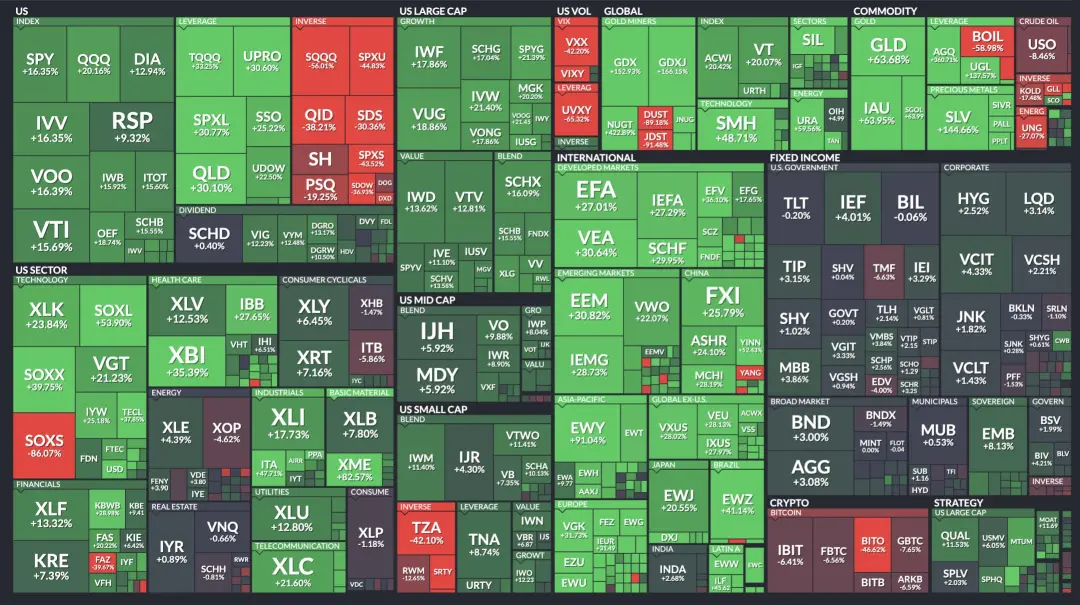

In the dynamic world of finance, 2025 ETF returns have captured the attention of investors worldwide, showcasing remarkable gains in technology and semiconductors amid broader market volatility. As we reflect on a year marked by AI advancements and geopolitical shifts, understanding these returns is crucial for building resilient portfolios. This comprehensive guide explores the standout performers, underlying trends, and strategic insights to help you navigate future opportunities.
Whether you’re a tech-savvy professional chasing growth or a business owner seeking diversified income, 2025 ETF returns highlight the power of exchange-traded funds in capturing market momentum. With record inflows exceeding $1.3 trillion into U.S.-listed ETFs, the year underscored a shift toward active strategies and thematic investments.
Let’s delve into the data and strategies that defined success.
The Landscape of 2025 ETF Returns: Key Trends and Challenges
2025 was a pivotal year for ETFs, with global markets delivering mixed but overall positive results. The S&P 500 rose 18%, developed markets climbed 27%, and emerging markets surged 30%, fueling broad-based ETF gains.
Source: ishares.com
However, not all sectors thrived equally. Technology and semiconductors led the pack, driven by explosive demand for AI chips and data centers, while energy commodities faced headwinds from fluctuating oil prices and geopolitical tensions.
Consider the color-coded heatmap of 2025 year-to-date ETF returns, which visualized performance across U.S. indices, sectors, commodities, and leveraged funds. Green shades dominated tech-heavy categories, with the Direxion Daily Semiconductor Bull 3x Shares (SOXL) posting an impressive +53.9% return, reflecting the sector’s dominance.
The Technology Select Sector SPDR Fund (XLK) followed closely at +23.8%, underscoring AI and chip demand as key drivers in a bull market.
On the flip side, inverse and energy ETFs lagged. The ProShares UltraPro Short QQQ (SQQQ) declined -30.6%, signaling strong equity momentum that punished bearish bets. The United States Oil Fund (USO) fell -8.6%, hampered by volatile oil prices amid shifts in global supply chains.
These disparities highlight a core challenge: navigating volatility in an era of rapid technological change and economic uncertainty.
Investor behavior added another layer. Despite pullbacks such as the S&P 500’s 9.1% drop in April buyers poured $27 billion into U.S. equity ETFs, demonstrating conviction in long-term growth.
Fixed-income ETFs also saw robust inflows of over $384 billion, up 30% from 2024, as investors sought stability amid Fed easing.
Yet, small-cap ETFs experienced outflows despite 15%+ returns, revealing a preference for large-cap tech over broader diversification.
Stories from the market further illustrate these trends. Precious metals ETFs dominated non-tech categories, with the iShares MSCI Global Silver and Metals Miners ETF (SLVP) soaring 212% due to inflation fears and trade-war concerns.
Gold ETFs like the VanEck Gold Miners ETF (GDX) gained 166%, attracting $43 billion in inflows as prices rose 60%.
These surges stemmed from global debt concerns and speculative demand, reflecting investors’ desire to hedge against uncertainty.
The problem? Many investors entered 2025 overexposed to underperforming assets such as energy or inverse funds, missing out on tech’s rally. Geopolitical events—including U.S. export restrictions on chips and China’s resource bans—amplified risks.
Source: deloitte.com
This context explains why 2025 ETF returns mattered—and how they can inform smarter strategies.
Semiconductor ETFs: The Powerhouse of 2025 ETF Returns
No discussion of 2025 ETF returns is complete without spotlighting semiconductors, which emerged as the year’s breakout sector. The industry hit a record $697 billion in sales, up 11% from 2024, propelled by generative AI chips exceeding $150 billion in revenue.
AI accelerators, data centers, and edge computing drove this growth, with AMD estimating a $500 billion market by 2028.
Leveraged ETFs like SOXL amplified these gains, delivering +53.9% as chip demand surged. Non-leveraged options, such as the VanEck Semiconductor ETF (SMH), also thrived, benefiting from companies like NVIDIA and TSMC. Advanced packaging technologies, such as TSMC’s CoWoS, scaled production from 35,000 to 70,000 wafers per month, supporting AI infrastructure.
What made semiconductors so resilient? AI integration across PCs (50% gen AI-enabled by year-end) and smartphones (30%) created exponential demand. However, challenges like talent shortages requiring 100,000 workers annually, and geopolitical tensions tempered optimism.
R&D spending reached 52% of EBIT, fueling innovation while pressuring margins.
For investors, this sector’s performance highlights the value of thematic investing. Diversifying into AI-focused ETFs mitigated single-stock risk, while global electrification trends boosted related assets such as copper miners, which rose 43%.
Tech Sector Dominance in Best Performing ETFs 2025
Beyond semiconductors, the broader tech sector powered many of the best performing ETFs of 2025. XLK’s +23.8% return exemplified this trend, with inflows into tech ETFs reaching $38 billion amid sector rotations.
Source: ishares.com
Growth outperformed value as AI and cloud computing reshaped industries.
High-yield tech ETFs, such as the JPMorgan Equity Premium Income ETF (JEPI), appealed to income-focused investors through covered-call strategies that outperformed traditional bonds.
Active ETFs captured 38% of fixed-income flows, reflecting a growing preference for flexible management in volatile markets.
Morningstar experts emphasized quality factors such as low volatility, diversification, and cost efficiency. Bond ETFs acted as portfolio ballast, reducing overall risk through low correlation with equities.
Crypto ETFs added volatility and excitement. Bitcoin ETFs like IBIT attracted $22 billion in inflows despite periods of negative returns, signaling long-term conviction. Ethereum ETFs followed with $10.3 billion in inflows, though leveraged products like BITX (-33.57%) highlighted downside risk.

The takeaway: tech offers scalability and exponential upside, but blending it with defensive assets enables sustainable growth.
Energy and Commodity ETFs: Lessons from Underperformers
While tech dominated, energy ETFs provided cautionary lessons in 2025 ETF returns. USO’s -8.6% decline reflected oil price volatility influenced by tariffs and supply disruptions.
However, performance varied across subsectors. The VanEck Oil Refiners ETF (CRAK) gained 26.04%, benefiting from refining margins, while the iShares Global Energy ETF (IXG) rose 4.08%.
Source: nerdwallet.com
Commodity allocations rose to 4% of total ETF inflows, led by gold at $43 billion.
Source: ishares.com
Copper and lithium ETFs, including the Sprott Junior Copper Miners ETF (COPJ), surged amid electrification demand.
Source: etf.com
The insight: energy’s cyclical nature requires precise timing, while diversification – particularly into renewables – helps manage transition risks.
Global and Thematic ETFs: Broadening Horizons in 2025
Global ETFs outperformed U.S. benchmarks, with the Vanguard Total World Stock ETF (VT) returning 22.4% versus the S&P 500’s 17.8%.
Emerging markets stood out. The iShares MSCI South Korea ETF (EWY) surged 90% on AI-driven optimism.
Thematic ETFs capitalized on geopolitical narratives, with the Global X Defense Tech ETF gaining 78%.
More than 1,000 new ETFs launched in 2025 – 84% actively managed expanding investor choice.
Source: ishares.com
This diversity reinforced the appeal of global exposure as a hedge against U.S.-centric risk.
People Also Asked: FAQ on 2025 ETF Returns
What were the best performing ETFs of 2025?
Precious metals ETFs like SLVP (+212%) and leveraged tech ETFs like SOXL (+53.9%) topped performance charts.
How did semiconductor ETFs perform in 2025?
Exceptionally well, supported by $697 billion in industry sales. SOXL led with +53.9% returns.
Why did energy ETFs underperform in 2025?
Oil price volatility and geopolitical disruptions hurt performance. USO fell -8.6%, while refiners like CRAK gained 26%.
Source: nerdwallet.com
Are leveraged ETFs worth it for 2025 returns?
They can amplify gains but significantly increase risk, making them more suitable for short-term strategies.
What ETF strategies work post-2025?
Diversify into AI and tech, hedge with commodities, and reinvest dividends using DRIP strategies.
Actionable Strategies from 2025 ETF Returns
As Kristy Akullian, CFA at iShares, notes:
“2025’s record flows signal a maturing ETF market, with investors embracing active and thematic strategies for resilience.”
To capitalize on these trends, reassess your portfolio: allocate 20–30% to tech and semiconductor ETFs like XLK or SMH for growth, balance with income-focused funds such as JEPI, and hedge through commodities.
For additional insight, watch the YouTube video “Top ETFs of 2025: Winners & Losers Revealed”, which breaks down outperformers like GOOP (+45.48%) and underperformers like BITX (-33.57%), highlighting how DRIP strategies boosted total returns by up to 7%.