

Key person risk is the possibility that a business loses earnings power, execution capability, or investor confidence when an unusually important individual leaves or becomes unavailable. For shareholders, the central question is not whether a founder is impressive. It is how much of the investment case depends on that person continuing to perform.
The issue surfaced in the bookmarked X accounts reviewed for this article. In a November 20, 2026 post, valuation professor Aswath Damodaran discussed how a chief executive’s contribution changes as a company develops. His NYU presentation on key person valuation provides a useful starting point: the value of leadership should connect to the economics of the business. The framework below applies that question without treating any executive as a guaranteed source of returns.
What does key person risk mean for investors?
A company may rely on one person for product judgment, customer relationships, fundraising, technical expertise, or its public identity. These dependencies are different. A gifted salesperson who personally controls several major accounts creates a different risk from a chief scientist whose research has already been documented and transferred to a strong team.
For a listed company, ownership of the shares survives a leadership change. What may change is the stream of cash the business can generate and the price investors are willing to pay for it. A management headline can affect the share price immediately, while the operational consequences emerge over several reporting periods.
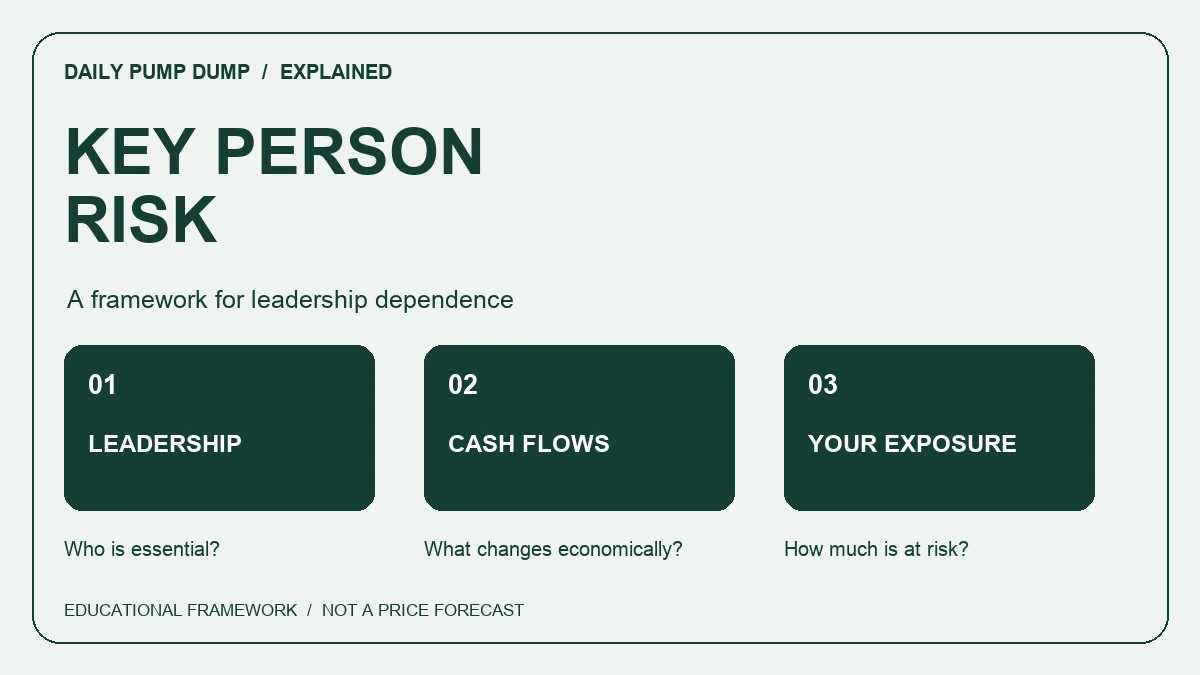
Separate three questions: What changed in the company, what changed in the market’s expectations, and what changed in your own exposure? Confusing those questions encourages buying or selling before there is a coherent investment thesis.
Trace the dependency through the business
Start with revenue. Does a departing executive personally win contracts, or does a repeatable sales process do the work? Are customers loyal to a product, a distribution network, a contractual relationship, or an individual? Customer concentration can magnify leadership concentration when both risks lead back to the same few relationships.
Next consider operating execution. A company may have valuable technology yet depend on one leader to prioritize projects and allocate scarce engineering resources. Look for evidence that operating managers can make decisions without constant intervention. Product delivery, employee retention, and spending discipline are more informative than a polished succession announcement.
Finally assess financing. A founder’s reputation can help raise money or negotiate with partners. That benefit is harder to replace when the business burns cash and needs frequent funding. A profitable company with substantial liquidity may have more time to adjust than an otherwise similar company approaching a refinancing deadline.
Build scenarios instead of choosing an arbitrary discount
A flat “founder discount” hides the mechanism you are trying to measure. A more useful exercise is to write a continuity case and a disruption case. Keep the assumptions explicit enough that a later earnings report can challenge them.
| Question | Continuity case | Disruption case | Evidence to monitor |
|---|---|---|---|
| Customer relationships | Contracts renew normally | Some customers delay commitments | Renewals and customer concentration |
| Product execution | Delivery schedule holds | Projects slip or require more spending | Milestones, margins, staff turnover |
| Financing | Existing resources cover the transition | External funding becomes necessary | Cash runway and debt maturities |
| Governance | Authority transfers clearly | Board and management disagree | Succession disclosures and responsibilities |
Consider a purely hypothetical business producing $100 million of annual free cash flow. If losing a key executive temporarily reduces that figure to $80 million, the initial shortfall is $20 million a year. Two years of disruption would mean $40 million less cash before accounting for timing, discounting, or recovery. That is a scenario assumption, not a claim about any company.
Now change one assumption: the executive’s departure permanently reduces the company’s competitive advantage. The effect is no longer limited to two weak years. Conversely, if authority has already been distributed successfully, the disruption case may be much milder. The exercise shows why the duration of damage matters as much as its first-year size.
A complete equity valuation also considers debt, cash, reinvestment needs, dilution, and the risk of the projected cash flows. Avoid subtracting the same problem twice by reducing expected earnings and then imposing a second unexplained penalty for precisely that earnings reduction.
Distinguish a strong leader from a fragile organization
Strong leadership and high dependency are not synonyms. An effective executive may reduce dependence on themselves by training successors, documenting decisions, and retaining specialists. A business that can operate during an extended absence may be more resilient than one where every approval must travel through a single office.
Read the annual report’s risk factors, proxy materials, management biographies, and relevant company filings. Look for the depth of the operating team, the board’s succession process, and who has actually run major business units. A designated successor is useful evidence, but it is not proof that customers and employees will accept the transition.
Insurance can address some financial consequences of losing an important person, especially in smaller businesses. It cannot manufacture product vision or rebuild a damaged customer relationship overnight. Treat insurance coverage, governance preparation, and operational redundancy as separate safeguards.
Measure the risk across the whole portfolio
Owning several funds does not necessarily eliminate exposure to the same company or leadership narrative. Examine their underlying holdings. A direct stock position, a technology fund, and a broad index fund can all contain the same business. Employment income or company share awards may add another layer of dependence.
The SEC’s Investor.gov guidance on allocation and diversification explains why spreading exposure can reduce risk, while leaving market-wide risks in place. In this setting, diversification is a way to limit how much one leadership outcome can change your financial plan.
Write a review trigger before the next headline: a missed operating milestone, a material change in funding needs, or evidence that succession is working. A predefined process is easier to follow than a decision made while watching an exceptionally volatile share price.
Questions investors also ask
How do you reduce key person risk?
At company level, succession planning, delegated authority, durable customer relationships, and knowledge transfer can reduce dependency. At portfolio level, examine overlapping holdings and decide how much company-specific loss your plan can absorb. Neither approach guarantees that a leadership change will be painless.
What is the main risk of investing?
There is no single risk that dominates every investment. Permanent loss, inflation, liquidity constraints, interest rates, and business failure matter differently across assets and time horizons. Key person risk is one component of business risk, rather than a substitute for a complete investment assessment.
What are the seven risk types?
There is no universal seven-part taxonomy. One useful checklist covers market, credit, liquidity, operational, concentration, currency, and regulatory risks. Leadership dependency can overlap operational and concentration risk, so counting categories should never replace investigating the underlying exposure.
A practical review before the next leadership headline
Summarize the investment case in one paragraph without using the executive’s name. Then identify which assumptions would fail if that individual could not work for a year. Record the evidence needed to confirm resilience or disruption. This turns admiration for leadership into a testable business assessment.
Also Read: ETF Inflows Explained: What Fund Flows Really Tell You adds context when changes in fund demand amplify company-specific price movements.
This article is educational analysis. Scenarios are hypothetical and are not price targets or personalized investment advice.


