

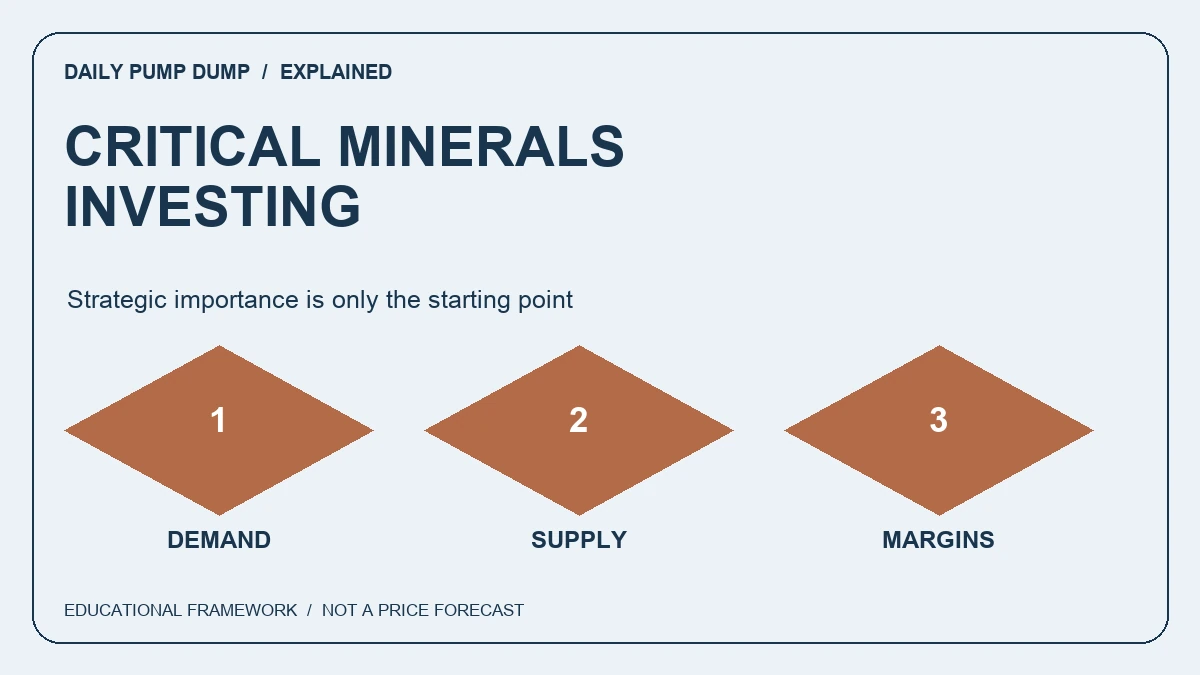
Critical minerals investing requires two separate judgments: whether a material is strategically important, and whether an investment can earn an attractive return at the price paid. The first does not guarantee the second. A metal can be essential to batteries, electronics, or electricity networks while its producers struggle with excess supply, rising costs, or restrictive export policies.
That distinction appeared in Javier Blas’s November 23, 2026 X commentary, where the commodities journalist contrasted the critical-minerals narrative with oversupply and export limits. His observation is a useful research prompt, not a standalone trading signal. This guide examines how to evaluate the business behind the mineral theme.
What are critical minerals?
A critical mineral is designated important because of its economic or strategic role and the vulnerability of its supply chain. The US Geological Survey’s explanation emphasizes essential functions and disruption risk. Criticality changes as technology, supply, and dependence change; it is not a permanent statement that a commodity must become more expensive.
It is also important to distinguish a mineral, an ore deposit, a refined chemical, and an investable security. A resource in the ground does not automatically produce battery-grade material. A processing bottleneck can matter even when mined output is abundant. A shareholder owns a claim on a company’s business, not a guaranteed quantity of profit from a strategic material.
Why strong demand can coexist with weak returns
Prices respond to the balance between available supply and demand, including inventories and expectations. Demand can grow rapidly while supply grows faster. Producers that expanded during a high-price period may bring new capacity online just as customers shift technologies or reduce their own stocks.
Time matters. A mine can require years of spending before meaningful production begins. An investor buying the company today may bear construction, funding, and operating risks long before the long-term demand story reaches its expected scale. Even an accurate forecast for electric-vehicle adoption says little about the valuation of a specific project without those intermediate steps.
The IEA’s 2026 critical minerals outlook describes different balances across minerals and scenarios. It also highlights substitution, project pipelines, and policy effects. Those conditional projections should be read as scenarios with assumptions, rather than a uniform forecast for every battery-metal investment.
Map the investment from demand to shareholder value
| Layer | Question to ask | Why it matters |
|---|---|---|
| End demand | Which products use the material? | Technology changes can alter demand intensity |
| Supply balance | What capacity and inventories can reach buyers? | Scarcity claims may overlook available supply |
| Project economics | What does usable output cost to produce? | Revenue growth does not ensure positive cash flow |
| Company financing | Who funds construction and working capital? | Debt and share issuance affect existing owners |
| Entry valuation | What success is already priced in? | A strong asset can still be an expensive investment |
Use this map in both directions. If you begin with an exciting demand headline, work down to the company’s cash generation. If you begin with a low share price, work upward to ask why buyers would want the company’s eventual product and whether competing supply can meet that demand more cheaply.
Stress-test margins before projecting a windfall
Consider a simplified, hypothetical producer selling one unit of material for $100 with $70 of unit operating costs. Its contribution before corporate costs, financing, taxes, and capital spending is $30. If the realized selling price falls to $80 and unit operating costs remain $70, that contribution falls to $10. A 20% revenue-price decline has reduced this simplified contribution by about 67%.
This is operating leverage, not a forecast for any particular mineral. The calculation becomes more complex when costs move with output, other metals provide by-product revenue, or long-term contracts influence realized prices. Its purpose is to show why a miner’s share price can react more sharply than the underlying commodity.
Ask what happens if the low-price period lasts longer than expected. Does the company have cash to finish construction? Can it meet interest payments? Will it sell new shares? A low production cost is valuable, but the balance sheet determines whether existing owners can remain invested long enough to benefit from a recovery.
Understand policy, geography, and processing exposure
Export restrictions can support one local objective while creating new problems for a particular producer or buyer. A company may have saleable material that cannot be exported on the expected timetable. Another business may benefit from a higher international price but face more expensive inputs. The relevant question is where in the supply chain the company earns its margin.
Study the location of mines, processing facilities, customers, and transport routes separately. “Exposure to a mineral” may actually mean exposure to one country’s permits, one refinery’s qualification process, or a small number of customers. Currency movements can further separate local operating costs from the price investors see quoted in dollars.
Company filings should explain material operating risks, development milestones, funding requirements, and contractual commitments. Read the technical assumptions behind the investor presentation. Reserve estimates, recovery rates, commissioning dates, and projected costs do not all carry the same level of certainty.
How can you invest in critical minerals?
Possible routes include individual mining or processing shares, diversified resource companies, and sector funds. Some markets also offer commodity-linked products, whose mechanics differ from company ownership. Access, regulation, fees, tax treatment, and suitability depend on the product and the investor’s jurisdiction.
A fund can reduce dependence on one mine while retaining concentrated exposure to a commodity cycle. Read its holdings and index rules. A fund described as a battery-materials investment may own diversified miners whose main earnings come from other products. A company with a promising deposit may be primarily a financing and development proposition today.
For any exchange-traded product, examine expenses, trading liquidity, spreads, and the structure used to deliver exposure. If futures are involved, returns can diverge from spot prices because contracts expire and must be replaced. A compelling sector narrative does not remove product-level risks.
Questions investors also ask
What are the top five critical minerals?
There is no universal top-five ranking. Lithium, cobalt, nickel, graphite, and rare earth elements are frequently discussed in energy-transition research, but their importance depends on the application and the government or institution defining the list. That illustrative group is not a ranking of expected investment returns.
Are there exactly 30 critical minerals?
No. Lists differ across jurisdictions and change over time. The US Department of Energy’s explanation of critical minerals and materials also distinguishes its energy-related materials framework from other official designations. Check the issuing authority and publication date whenever a fixed number is quoted.
Is a critical mineral automatically a good investment?
No. Strategic importance does not establish an attractive purchase price, a profitable project, or a well-financed company. The investment case must connect demand to supply, costs, cash generation, and the security’s valuation. The same demand theme can produce both strong and weak investments.
Build a research checklist that survives a price cycle
Record the mineral, the part of the supply chain, the company’s funding needs, and the assumptions required for positive cash flow. Compare the base case with a lower-price, delayed-project case. Decide which disclosed milestones would strengthen or weaken the thesis, rather than treating every price decline as proof that the market is wrong.
Also Read: ETF Inflows Explained helps separate changes in investor demand for a fund from improvements in the businesses it holds.
Educational analysis, not a recommendation to buy a mineral, company, or fund. The numerical example is hypothetical and excludes several real-world costs.


